Connections
Glasnevin Cemetery
Ireland's national cemetery, and one of Power's most important sites
Glasnevin Cemetery, founded in 1832 by Daniel O'Connell, is the resting place of many of the figures Albert Power commemorated in portrait and monument throughout his career. It is also where Power himself is buried, following his death in July 1945. Across several decades, he produced funerary monuments, private memorials, and public commissions for the cemetery — making Glasnevin one of the most concentrated sites of his work in Ireland.
Power's association with Glasnevin connects the two dimensions of his practice: the private grief of family memorials and the public commemoration of the nation's revolutionary dead.
The Young Irelanders Monument — Unfinished
Monument to the Young Irelanders
Designed but incomplete · Glasnevin Cemetery, Dublin
Power was commissioned to design a monument to the Young Irelanders — the revolutionary nationalist movement of the 1840s centred on Thomas Davis, Charles Gavan Duffy, and William Smith O'Brien — for Glasnevin Cemetery. Work began in 1938, with the aim of completing it in time for the 25th anniversary of the Easter Rising in 1941. The design included Irish wolfhounds as a central sculptural element, for which Power was specifically responsible. However, owing to lack of funds, the wolfhounds were never cast in bronze, and the monument remained incomplete at the time of Power's death in 1945.
The Young Irelanders monument stands today in the cemetery, though without the wolfhounds Power had designed for it — a reminder of how many of his ambitions were constrained by the economic realities of the new Irish state.
Sources: JSTOR — "Towering above: memorials that stand out from the crowd" (Bennett, 2021); Glasnevin Cemetery Museum.
Private Memorials & Funerary Monuments
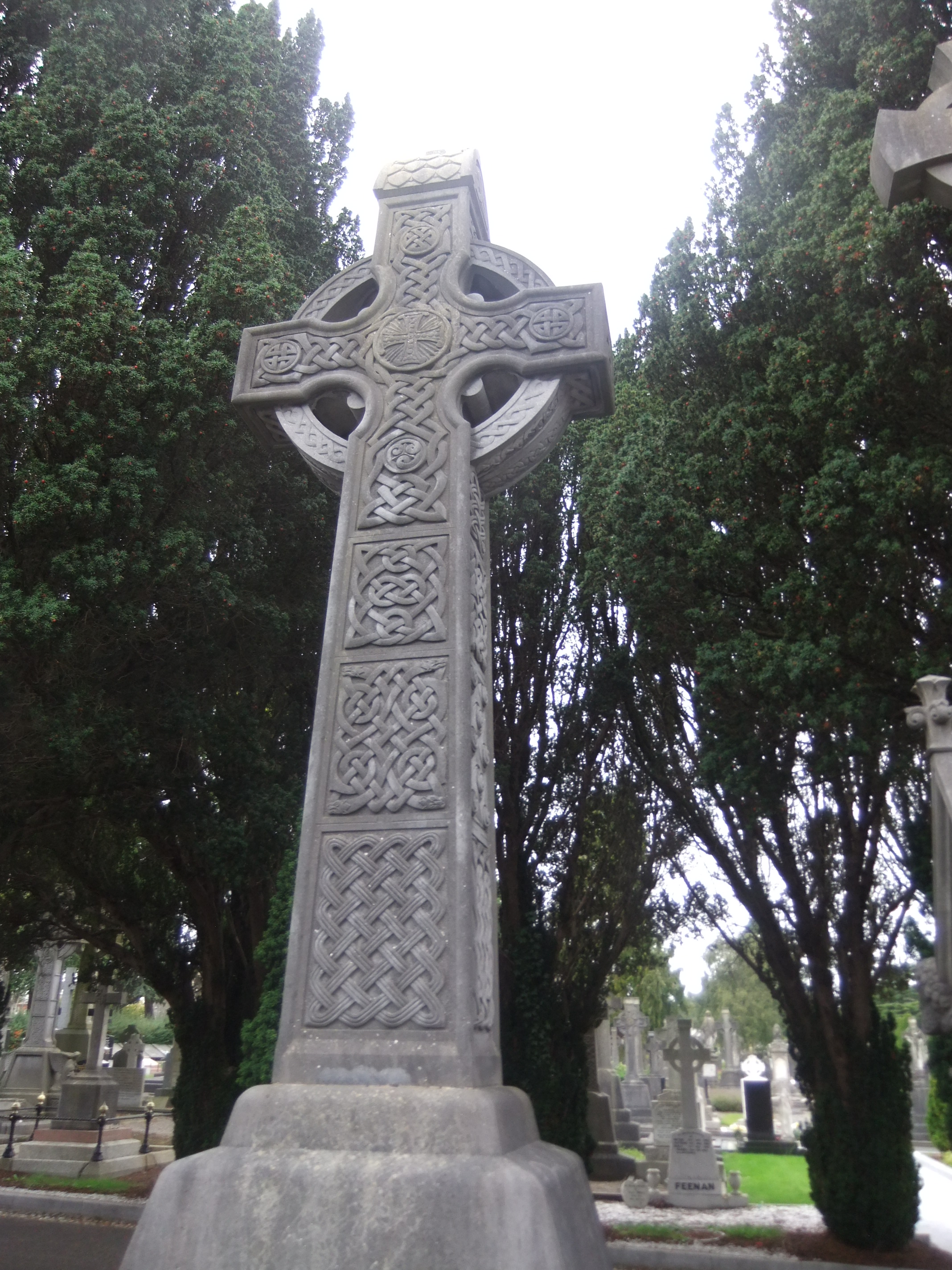
Memorial to John and Mary McKernan
Limestone · Glasnevin Cemetery, Dublin
A large funerary cross monument commissioned by Fr John McKernan, a chaplain at University College Dublin, in memory of his parents John and Mary McKernan (d. 1937). The work is among Power's most ambitious cemetery commissions — a tall limestone cross with a finely carved crucified Christ on the upper shaft, eyes closed, head bearing the crown of thorns beneath the INRI inscription, with a radiating halo. The lower shaft carries figural relief panels depicting sacred scenes. A separate memorial stone nearby records Mary Alicia Trench.
Source: Síghle Bhreathnach-Lynch, Expressions of Nationhood in Bronze & Stone. Photographs © Brian Lynch.
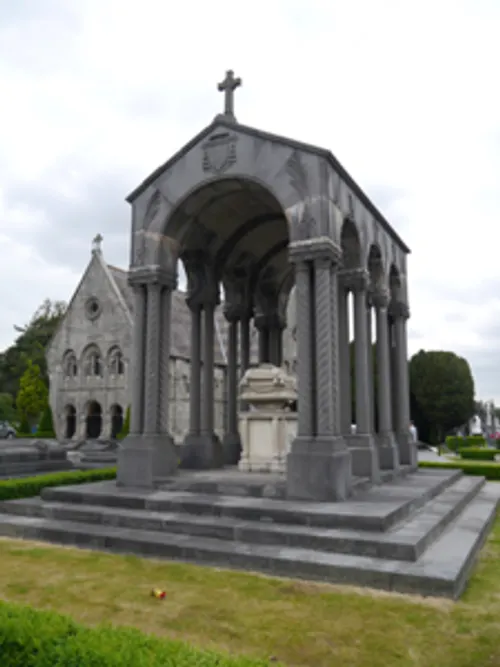
Archbishop Walsh Memorial
Stone figure and sarcophagus · Glasnevin Cemetery, Dublin
Architectural canopy by John J. Robinson; sculpture by Albert Power
Power's major ecclesiastical commission at Glasnevin — and one of the most significant funerary monuments in the cemetery. The memorial honours Archbishop William Joseph Walsh (1841–1921), Catholic Archbishop of Dublin from 1885 until his death, a pivotal figure in Irish public life who supported Parnell and later Sinn Féin, and whose influence shaped the relationship between the Catholic Church and the Irish independence movement.
The monument takes the form of a large open stone canopy — a baldachin structure designed by architect John J. Robinson — beneath which Power carved the recumbent figure of the Archbishop and the sarcophagus. The columned granite canopy, visible from across that section of the cemetery, gives the work an extraordinary monumental presence. Power executed the commission between 1926 and 1929.
This commission was among the most prestigious of Power's career and directly led to further ecclesiastical commissions — including work at the Cathedral of Christ the King, Mullingar, Co. Westmeath.
Photograph: Power family archive.
Further Confirmed Commissions
Limestone and bronze · Glasnevin Cemetery, Dublin
Additional confirmed funerary commissions at Glasnevin include the Downes Monument (1925) and the Cait O'Kelly Memorial (1936). Power continued to receive Glasnevin commissions throughout his career, reflecting his standing as the pre-eminent funerary sculptor in Ireland during the 1920s and 1930s. Further monuments attributed to Power are likely present in the cemetery but have not yet been fully documented.
Power's Own Grave
Albert George Power RHA died on 10 July 1945, aged 63, following complications from a double hernia. He is buried in Glasnevin Cemetery — among the very figures he spent his career commemorating in stone and bronze. The cemetery holds the graves of Michael Collins, Arthur Griffith, Cathal Brugha, and many of the other revolutionary leaders whose death masks and portraits Power made in the decade following independence.