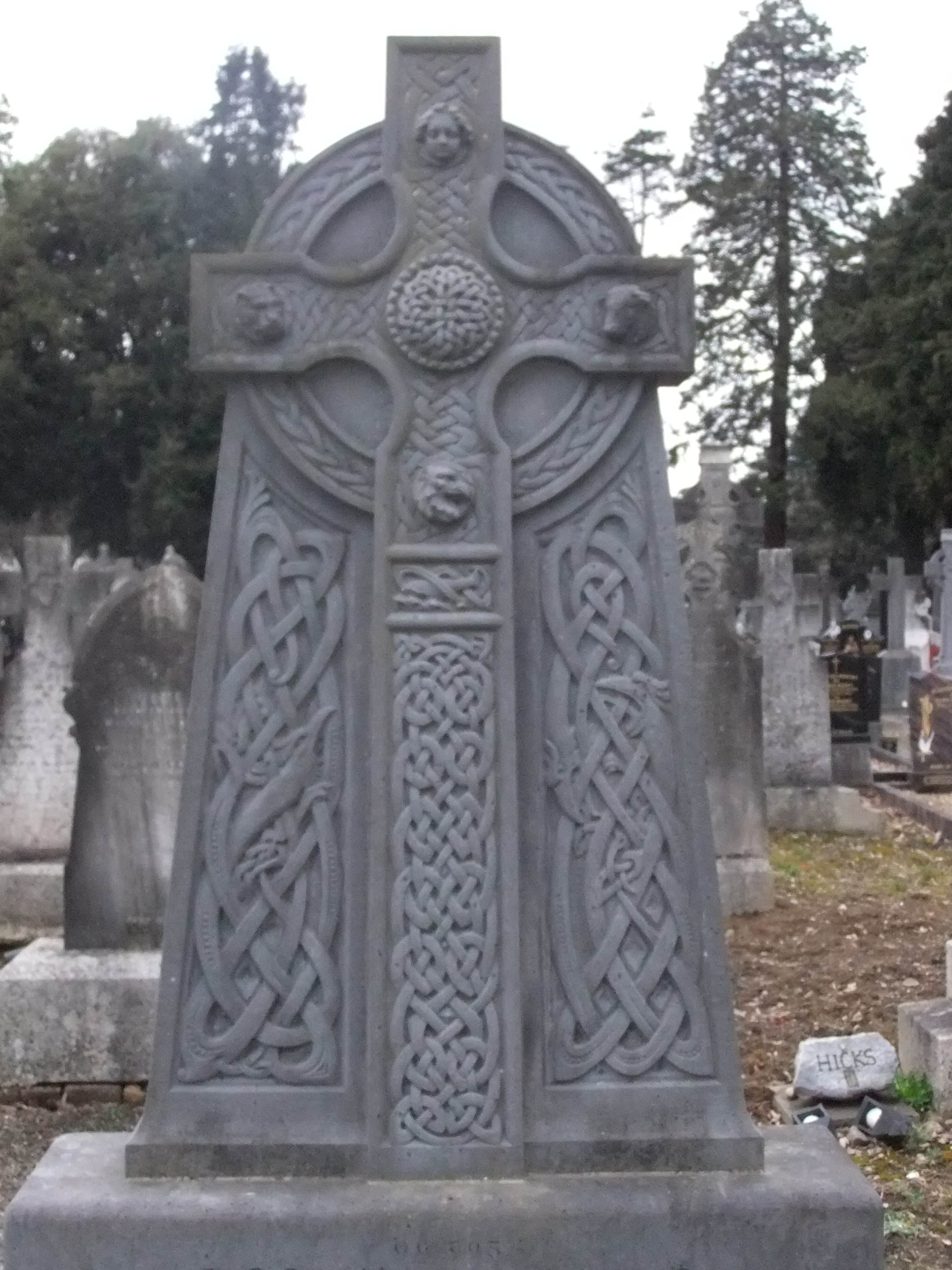
The Cait O’Kelly Memorial (1936) at Glasnevin Cemetery is among the most elaborate of Power’s funerary commissions — a Celtic high cross carved with dense interlace panels along both the shaft and the arms, small carved heads set at each of the cross’s four intersections, and a richly worked circular boss at its centre.
The form draws directly on early medieval Irish high crosses, a revivalist idiom widely used in Irish ecclesiastical and funerary sculpture of the period, but the depth and precision of the carving — particularly the interlace work running the full length of the shaft — sets it apart from simpler contemporary examples nearby in the same cemetery.
It sits within Power’s substantial body of funerary work at Glasnevin, alongside the Downes and Lardner Monuments (1925), the Archbishop Walsh Memorial (1926–29), and the McKernan Memorial (1937–40).