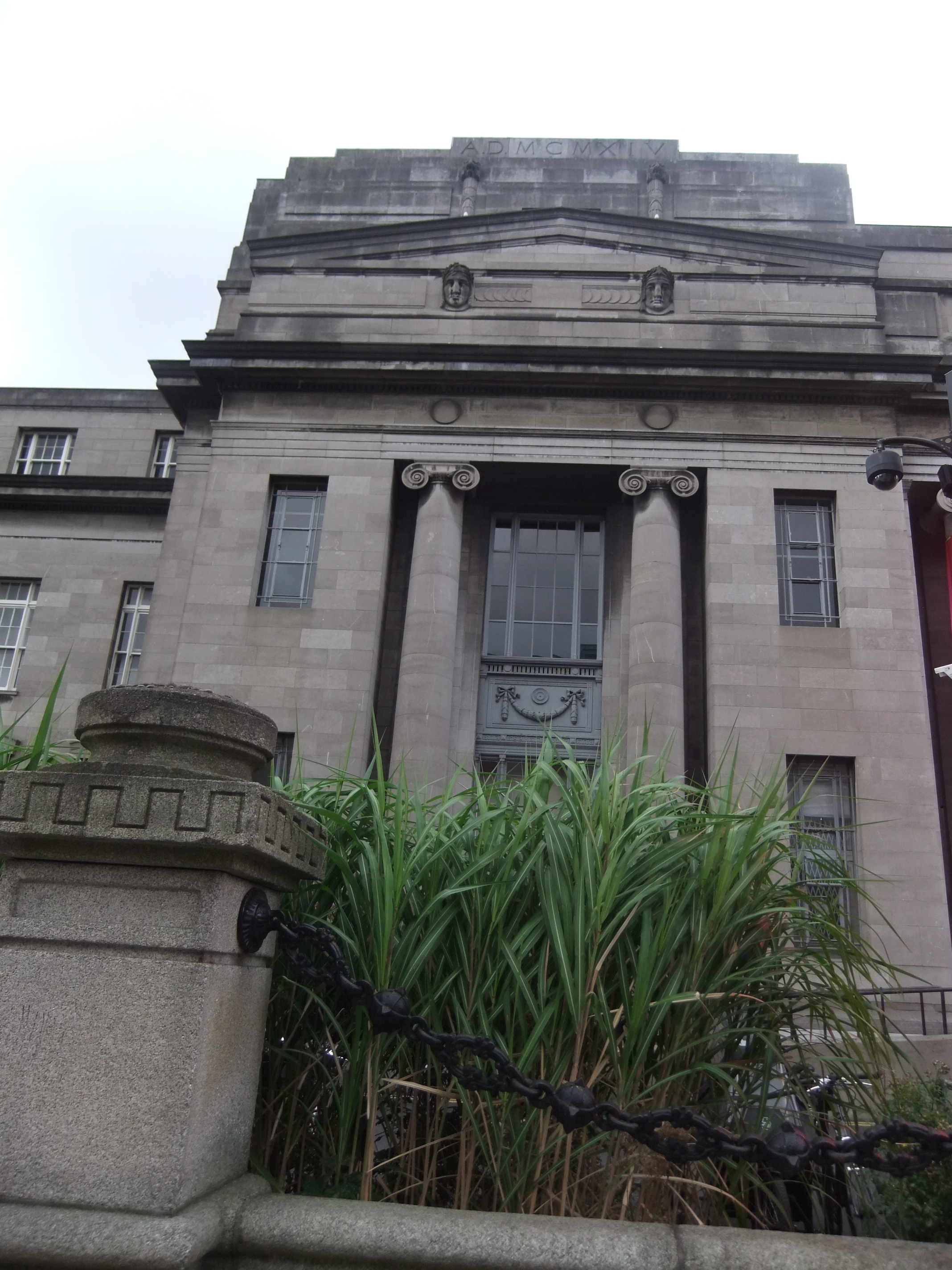
In 1914, Albert Power carved a series of fourteen heads of notable figures on the upper facade of the building now known as the National Concert Hall, Earlsfort Terrace, Dublin. The building’s pediment carries the inscription “A.D. MCMXIV” — 1914 in Roman numerals — marking the year of its completion.
The building originally served as the Royal University of Ireland and later University College Dublin’s Earlsfort Terrace campus, before being converted into the National Concert Hall in 1981. Power’s carved heads — classical in style, some bearded and crowned in the manner of allegorical or historical figures — sit within the building’s pedimented facade above paired Ionic columns, characteristic of the restrained classical idiom favoured for major civic and educational buildings in Dublin in the years immediately before the First World War and the 1916 Rising.
This commission represents one of Power’s earliest major architectural decorative works, predating his later commissions for the Munster & Leinster Bank (1917), Royal Bank of Ireland (1919), and Gresham Hotel (1926) on O’Connell Street.